
Controversial_Ideas , 6(2), 20; doi:10.63466/jci06020020
Article
The Cass Review and the Psychology of Evidence-Based Course Correction
1
Institute of Neurology, University College London, Queen Square, London WC1N 3BG, UK
*
Corresponding author: s.baxendale@ucl.ac.uk
How to Cite: Baxendale, S. The Cass Review and the Psychology of Evidence-Based Course Correction. Journal of Controversial Ideas 2026, 6(2), 20; doi:10.63466/jci06020020.
Received: 3 January 2026 / Accepted: 25 September 2026 / Published: 10 November 2026
Abstract
:The Cass Review (2024) was commissioned by NHS England as an independent review of the medical treatments offered to children with gender-related distress. It concluded that the clinical care for children questioning their gender identity was ‘remarkably weak’. The responses to the Cass Review provide a case study in what happens when a recommended course correction in medicine comes up against strong professional and institutional investment in an existing model of care. Reactions to the Cass Review went well beyond routine professional disagreements about clinical evidence. This paper examines some of the responses to the Cass Review through the lens of recent advances in our understanding of cognitive bias and defensive reasoning. Analyses of the responses reveal how evidence can be filtered through prior belief, group allegiance and efforts to preserve a coherent account of past and present judgement. The paper draws practical lessons from this episode. Cognitive biases are, by their very nature, unconscious but can leave tell-tale traces of their presence in observable behaviours. These can include rapid dismissal of unwelcome findings, disproportionate emotional reactions to disconfirming evidence and those presenting it, asymmetric scrutiny of evidence, shifting rationales to maintain a fixed course of action, and the tendency to treat some evidence as contaminated due to the source while accepting belief-consistent evidence more readily. Measures to minimise the influence of cognitive bias in clinical practice are proposed, including the systematic examination of disconfirming cases and rigorous red team exercises to challenge settled positions. These measures will not work unless they are embedded in a clinical culture where changing one’s mind is treated as a strength and a core feature of evidence-based medicine.
Keywords:
Cass Review; gender dysphoria; gender-affirming care; cognitive bias; evidence-based practiceIntroduction: The Cass Review
Referrals of children and young people to gender identity clinics across the world rose dramatically in the second decade of this century. In the UK, the Gender Identity Service (GIDS) received 72 referrals in 2009–2010. This increased to 2,364 referrals in 2018–2019. The increase in the number of females referred to the service rose by over 5000% over this period (Cass, 2024). Similar dramatic changes in the patterns of referral were seen in the youth gender clinics in mainland Europe, the USA, Canada and Australia. These changes occurred in the context of growing uncertainty about the evidence supporting the treatments offered in these services. In 2020, in response to these concerns, NHS England commissioned an independent review of the gender services for children and young people. Led by Dr Hilary Cass, a consultant paediatrician and former President of the Royal College of Paediatrics and Child Health, Cass was tasked with making recommendations for safe and effective care for children and young people presenting with gender distress. The final Cass Review was published in April 2024.
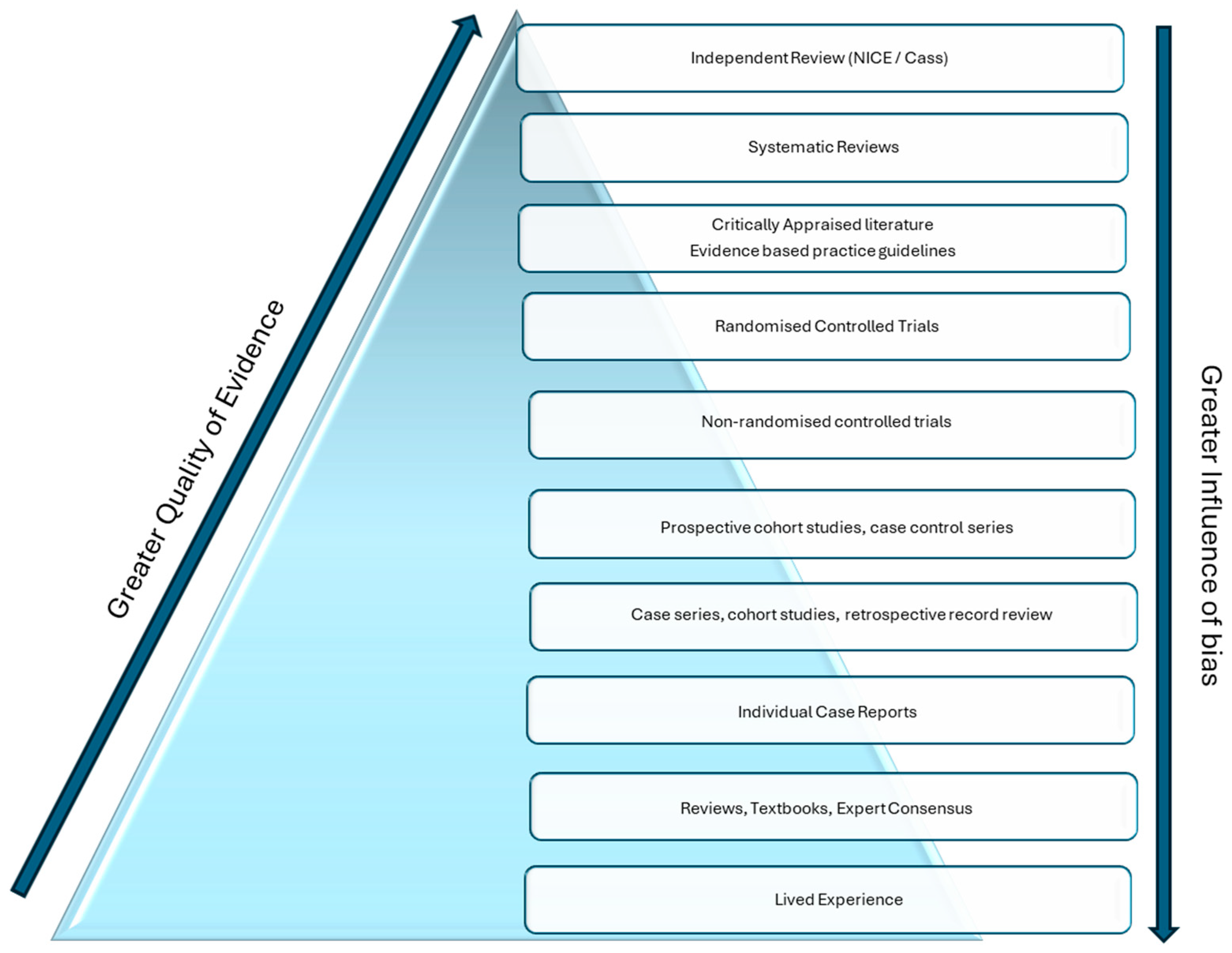
The methodology of the review encompassed systematic literature reviews, guideline appraisals, qualitative and quantitative research and epidemiological analyses. In terms of the hierarchy of evidence pyramid in medicine (Figure 1), the Cass Review sits close to the top, since not only was Cass able to thoroughly appraise all of the existing literature, she was able to commission her own systematic reviews and studies to help her evaluate the evidence. Very few medical treatments have been so thoroughly appraised.
Figure 1.
Levels of Evidence: Quality and Bias.
Cass (2024) concluded that ‘while a considerable amount of research has been published in this field, systematic evidence reviews demonstrated the poor quality of the published studies, meaning there is not a reliable evidence base upon which to make clinical decisions, or for children and their families to make informed choices’. The Review recognised the complex biopsychosocial factors that contributed to gender identity and acknowledged that whilst medical transition may be the best outcome for some young people, others may resolve their distress in other ways. Unfortunately, clinicians were unable to determine which children and young people fell into each group: ‘The evidence is weak and clinicians have told us they are unable to determine with any certainty which children and young people will go on to have an enduring trans identity’ (Cass, 2024: 22). This left gender-affirming care in a very difficult position: medical transition might be appropriate and beneficial for some young people, but without reliable means of identifying that subgroup in advance, the same interventions risked being offered to others on whom they could confer irreversible and significant harm. This was a particular concern given the evidence that, once commenced on puberty blockers, most young people remained on a medical pathway, progressing to cross sex hormones with irreversible effects.
The clinical implications of these conclusions were seismic: thousands of young people were waiting for medical interventions that many believed to be urgent or even life-saving, yet the Cass Review had concluded that not only was the evidence for benefit ‘shaky’, it did not allow clinicians to distinguish confidently between those who could benefit from those who might be harmed. This tension alone would have been enough to generate intense professional debate, but the reception of the Cass Review did not unfold in a neutral clinical space.
Sociopolitical Context
The Review was launched in a sociopolitical environment in which debate about gender-affirming care had already become intensely charged. Questions that would ordinarily be framed as matters of clinical uncertainty and evidence quality in a specialist medical setting had already become entangled with wider societal debates about biological sex and gender identity. Ethicists and philosophers debated whether access to the treatment was a human right and a matter of bodily autonomy or an issue of safeguarding and part of an evolving medical scandal. In some regions, particularly the United States, positions on paediatric gender medicine were strongly polarised along left-right political affiliations. As a result, for the public at large, it was already difficult to separate discussion of these issues from political affiliation. The result was a tinderbox: gender-affirming care was a field in which uncertainty was hard to acknowledge and any disagreement was readily politicised. It is therefore entirely predictable that the Cass Review would be warmly welcomed by some and interpreted as persecution by others.
Responses to the Cass Review
Inaccurate claims circulated on social media within minutes of the Cass Review being published, including that Cass had excluded all the positive studies or demanded double-blind randomised controlled trials as the only acceptable evidence of efficacy. Whilst few would rely on social media for a nuanced critique of any topic, some of these inaccuracies were nevertheless repeated in some professional commentaries which then began to reference each other (Aaron and Konnoth, 2025; McNamara et al., 2024).
On social media, the complex clinical problem was often distilled into two competing narratives: either that all gender-distressed young people were trans and being denied necessary treatment due to bigotry, or that the phenomenon was entirely the product of a social contagion. This binary framing eclipsed one of the central messages of the Cass Review which stressed that there were many pathways into a trans identity and many pathways out.
Faced with the stark contrast between expert consensus (gender-affirming care is the gold standard) and the conclusions of the review (there is no reliable evidence base upon which to make clinical decisions), some clinicians elevated expert consensus from the bottom to the top of the medical evidence pyramid (possibly mistaking expert consensus for evidence-based clinical guidelines – see Figure 1). Others challenged the Review’s conclusions on the grounds that they conflicted with their own clinical experience, prioritising their personal clinical experience over the Review’s stronger evidential foundation.
In addition to individual responses, the Review attracted a range of professional critiques. These critiques were not uniform in status or in the validity of their arguments; some were peer-reviewed academic papers, others were professional statements or grey-literature reports (see Table 1). The critiques ranged from conceptual objections to the framing of gender-related distress as a medical disorder at all to challenges to the methodology Cass used to gather and appraise the evidence. These criticisms came from clinicians working in the field and ethicists and legal scholars who were concerned about the translation of clinical uncertainty into medical restriction. Professional bodies, including the World Professional Association for Transgender Health (WPATH), the United States Professional Association for Transgender Health (USPATH), the European Professional Association for Transgender Health (EPATH) and the Endocrine Society, also challenged aspects of the Review’s interpretation of evidence, recommendations, and potential implications for access to care. These critiques are summarised in Table 1.

Table 1.
Major Published Critiques of the Cass Review.
| Authors/Body | Journal/Publication Platform | Summary of Major Objections |
|---|---|---|
| Horton (2025) | International Journal of Transgender Health |
|
| Grijseels (2024) | International Journal of Transgender Health |
|
| McNamara et al. (2024) | Web Blog Yale Law School Integrity Project Report |
|
| WPATH and USPATH (2024) | Professional statement |
|
| Endocrine Society (2024) | Professional statement |
|
| EPATH (2024) | Professional statement |
|
| Vandermorris et al. (2024) | Paediatrics & Child Health |
|
| Noone et al. (2025) | BMC Medical Research Methodology |
|
| Aaron and Konnoth (2025) | New England Journal of Medicine |
|
| Giordano (2025) | Journal of Medical Ethics |
|
| Moore et al. (2025) | Medical Journal of Australia |
|
| Moser (2025) | Archives of Sexual Behavior |
|
Note: This table summarises major published critiques and professional responses; it does not evaluate the accuracy of each critique.
The criticisms of the Cass Review in these papers cluster around several recurring themes. Methodological critiques focused on the ways in which the authors who had conducted the systematic reviews had graded the evidence, highlighting the discrepancies between the protocols that were initially planned and those that were employed in the subsequent published studies. There were concerns that the conclusions of the Review gave disproportionate weight to the uncertainty surrounding medical interventions, while giving less scrutiny to the harms of withholding treatment or to the scant evidence base for psychological alternatives (an evidence base which can only be described as ‘applied’ at best). Ethical and legal critiques focused on the policy implications of the conclusions and the translation of uncertainty into the restriction of medical care. They raised particular concerns about the recommendation that puberty blockers should only be available within a research framework and the coercion to participate in a trial that this would involve. The professional-body responses highlighted the significant gap between the findings of the Cass Review that gender-affirming care had shaky foundations with their own guidelines which promoted these treatments as safe and effective and the gold standard of care. A further group of criticisms situated the Review within the wider political context, arguing that trans expertise and lived experience were marginalised and expressed concerns that the Review would be used to justify policies that went beyond its own conclusions.
Scrutiny of the Critiques
These critiques were themselves subjected to close scrutiny. Debate about the interpretation of evidence and the implementation of recommendations is legitimate and in a healthy clinical academic environment it should be expected and encouraged. However, a number of criticisms of the Cass Review did not simply contest its conclusions. They misrepresented what the Review had done. For example, publishing in the New England Journal of Medicine, Aaron and Konnoth (2025) reported that Cass had only found 1 of 53 hormone studies to be of high quality because she had embraced randomised controlled trials (RCT) as standard. In fact, the review did not require a high-quality study to be an RCT. It used a standardised assessment tool to assess the quality of all study types. The 52 hormone studies that didn’t make the grade were judged to be low quality because they were poorly conducted, not because they were not RCTs (Kingdon et al., 2025).
In Kingdon et al. (2025), Cass herself addressed recurrent claims that the Review misunderstood evidence-based medicine, imposed an impossible evidential threshold, excluded lived experience, or was politically motivated. The authors argued that some prominent critiques, including the NEJM Perspective (Aaron and Konnoth, 2025) and the Yale Law School essay (McNamara et al., 2024), reflected a misunderstanding of both the UK independent review process and the Review’s evidential approach. They stressed that the Review did not reject medical transition in principle. It recognised that a medical pathway may be appropriate for some young people, but argued that weak evidence, diagnostic uncertainty and poor long-term follow-up data meant that clinicians simply did not have the evidence base upon which to make informed decisions about these pathways.
Cass made the same points in public interviews and evidence sessions. She stressed that the Review did not discard 98% of studies and did not insist on randomised controlled trials (Scottish Parliament, 2024). She also rejected the claim that the attention to detransition in the Review was a covert argument against care. The purpose, she said, was to understand less successful outcomes and whether there had been earlier warning signs, ‘not telling them they can’t do it’ (Scottish Parliament, 2024).
Further independent fact-checking reached similar conclusions. McDeavitt et al. (2025) reviewed four prominent critiques of the Cass Review in the peer-reviewed and grey literature and found that each contained claims that were inaccurate or lacked essential context. Cheung et al. (2025) focused more specifically on the policy and legal aspects of these critiques. Echoing many of the arguments of Kingdon et al., they argued that the Yale critique and related non-peer-reviewed sources confused an independent service review with a clinical guideline. The York systematic reviews were also misrepresented. The authors expressed concern that these misconceptions risked obstructing necessary reform of services for gender-distressed children and young people.
Robust engagement with the conclusions of any major medical review should be encouraged, particularly when a review challenges an accepted clinical status quo. The British Medical Association’s (BMA) response to the Cass Review illustrates the value of such scrutiny. In July 2024, the BMA passed a motion to publicly critique the Cass Review and oppose the implementation of its recommendations (Banfield, 2024). The decision provoked substantial opposition from the membership, many of whom believed the proposed critique was ideologically motivated. However, when it was completed in May 2026, the BMA’s evaluation concluded that Cass’s methodology was robust and the organisation no longer opposed any of the Review’s 32 recommendations (Hayward, 2026). Professor David Strain, who led the BMA evaluation, reported that Cass had been ‘vindicated’ in her handling of the data and, when asked to name a single recommendation the BMA still opposed, he replied: ‘I can’t.’ Nevertheless the BMA remained critical of the UK government’s policy responses to the conclusions of the Cass Review.
The episode underlines a wider point. Critique is essential, but it has to be anchored in facts and evidence. It is not helped when errors of fact are introduced into the debate, amplified on social media, and then repeated in the medical literature. In the case of the Cass Review, substantive engagement with the evidence was too often forestalled by factual misstatements, ad hominem attacks on Cass and her team, and objections to the tone or potential implications of the Review, paving the way for an easy and early dismissal of the conclusions.
Why Evidence-Based Course Correction Is Difficult
Why did this happen? The intensity of some responses reflects a familiar pattern in medicine. When evidence unsettles accepted practice, resistance is rarely driven by data debates alone. It is also shaped by cognitive bias, threats to professional identity, sunk costs and group loyalties which are all influenced by the wider sociopolitical environment. Viewed in this light, the reception of the Cass Review mirrors previous patterns in medical history where clinicians resisted evidence-based course corrections, particularly when those corrections indicate that clinical practice, however well-intentioned, may have become unmoored from the evidence base (Baxendale, 2025).
The Cass Review is a contemporary case study in how clinicians react when evidence conflicts with the prevailing culture and practice in a field of medicine. Doctors like to think of their profession as rational and self-correcting. Very often it is not. Once a treatment model becomes established, it quickly becomes enmeshed with professional identity, institutional reputation and the credibility of those who practice and promote it. When a patient group is vulnerable, this attachment can be intensified by advocacy and moral purpose. Defending the intervention can come to feel synonymous with defending the patients themselves. In medical fields that have become focal points for wider social and political debate, clinical uncertainty can be experienced as threatening, creating conditions in which a range of cognitive biases may be mobilised in defence of existing beliefs and practices, in an effort to maintain the status quo.
Cognitive Biases and Evidence-Based Practice
The modern study of cognitive bias was pioneered in the 1970s by Daniel Kahneman and Amos Tversky, who demonstrated that human judgement is systematically shaped by cognitive shortcuts and biases rather than operating as a neutral assessment of available information (Kahneman, 2011; Tversky and Kahneman, 1974). These shortcuts are not flaws in themselves: they are adaptive and efficient, and allow us to act quickly without endlessly analysing every possibility. Unfortunately the same mental shortcuts that typically serve us well, also systematically distort our judgement. They make us see patterns that are not there and prioritise evidence that confirms what we already believe. As a result, we are primed to dismiss information that threatens our prior assumptions.
Many of the responses to the Cass Review can be understood via well recognised cognitive biases (see Table 2). Confirmation bias shapes the way new information is filtered through prior knowledge: findings that support an existing belief are treated as decisive, while those that complicate it are subjected to greater scepticism or minimised. Availability bias gives disproportionate weight to emotionally salient stories. These could be accounts of benefit and success on the one hand or instances of regret, distress or harm on the other. Action bias is a significant issue in all fields of medicine. It is the imperative to do something. Patients and their doctors are very susceptible to this. Action bias makes an intervention a much more attractive option than passive, watchful waiting. In some scenarios, the latter can feel a lot like neglect. Sunk-cost fallacies make course correction very difficult once a model of care has become embedded in a service, where changes may threaten professional identity and institutional reputation. Together, these biases can generate the therapeutic illusion: the tendency for clinicians to overestimate the effectiveness of treatments they provide.
Table 2.
Cognitive and Motivational Biases Relevant to the Interpretation of Contested Medical Evidence.
Table 2.
Cognitive and Motivational Biases Relevant to the Interpretation of Contested Medical Evidence.
| Name of Bias | Summary of Bias | How It Might Shape Reactions to the Cass Review |
|---|---|---|
| Confirmation bias | The tendency to notice, trust and remember evidence that supports an existing belief, while scrutinising or dismissing evidence that challenges it. | Evidence consistent with prior views on gender-affirming care may be treated as decisive, while findings that complicate those views may be minimised, rejected as flawed, or framed as politically motivated. |
| Availability bias | The tendency to judge risk or probability by the most vivid, recent or emotionally powerful examples that come to mind. | Highly salient accounts of benefit, regret, suicide risk, detransition, family distress or clinical harm may dominate interpretation, even when they do not provide reliable evidence about population-level outcomes. |
| Sunk-cost bias | The tendency to continue defending a position or practice because significant time, reputation, resources or identity have already been invested in it. | Clinicians, services or professional bodies that had endorsed a particular model of care may find it difficult to accept that the evidence base is weaker than previously assumed, because doing so may feel like repudiating past practice. |
| Action bias | The tendency to prefer intervention over delay, especially when a situation is perceived as urgent, distressing or emotionally charged. | In the face of distressed young people and families, medical intervention may feel more compassionate and clinically responsible than extended assessment, watchful waiting or psychological support, even where evidence for benefit is limited. |
Belief-Consistent Processing and Coherence-Based Reasoning
These are by no means the only cognitive biases that shape medical beliefs and practices. Psychological research has identified well over one hundred named biases, but recent work has tried to move beyond an ever-expanding catalogue, focusing instead on the mechanisms that sit beneath them. Oeberst and Imhoff (2023) identified six default beliefs that shape cognitive bias. These are: that my experience is a reasonable reference; that I make correct assessments; that I am good; that my group is a reasonable reference; that my group is good; and that people’s attributes, rather than context, explain outcomes (see Table 3). As with the other individual cognitive biases, these meta-beliefs are adaptive, not pathological. However, they act as a distorting lens when information is processed in ways that preserve them.
Belief-consistent information processing describes how our prior beliefs guide what we notice, trust, remember and discount. Coherence-based reasoning describes how the mind tries to make new information fit into a coherent account (Oeberst et al., 2025).
Table 3.
Default Beliefs and Belief-Consistent Processing in Responses to the Cass Review.
| Fundamental Belief | What It Means | Biases It Can Generate | Relevance to Responses to the Cass Review |
|---|---|---|---|
| My experience is a reasonable reference | People use their own experience as a default yardstick for judging other people, situations and risks. | Spotlight effect; illusion of transparency; false consensus effect; social projection. | Clinicians, patients, parents and advocates may treat their own experience of benefit, regret, distress or harm as more representative than it is. Lived and clinical experience may become a proxy for population-level evidence. |
| I make correct assessments of the world | People tend to assume that their own judgements are accurate and less biased than those of others. | Bias blind spot; hostile media bias; motivated scepticism. | Critics and defenders may each see themselves as following the evidence, while viewing opposing interpretations as ideological, ignorant, politically motivated or methodologically naive. |
| I am good | People protect a positive view of themselves as competent, moral and well intentioned. | Better-than-average effect; defensive attribution. | Clinicians who acted in good faith may find it difficult to accept evidence suggesting that practice may have outrun the evidence, or that some patients may have been harmed. The threat is both evidential and moral. |
| My group is a reasonable reference | People treat the assumptions, norms and practices of their own group as the natural or reasonable standard. | Ethnocentric bias. | Different professional, activist, legal, psychiatric, paediatric or evidence-review communities may each assume that their own framing of the problem is the most reasonable one. |
| My group members are good | People process information in ways that preserve the moral standing of their own group. | In-group bias; partisan bias. | Challenges from outside the group may be rejected more defensively than the same challenge from within. Criticism of practice may be heard as an attack on clinicians, trans people, safeguarding, progressive values or patient advocacy, depending on group identity. |
| People’s attributes shape outcomes | People tend to explain outcomes by traits, motives or failings rather than wider circumstances or systems. | Fundamental attribution error. | Responses may over-personalise the controversy by blaming Cass, clinicians, activists, parents or patients, instead of examining how weak evidence, service pressure, institutional incentives, political heat and poor follow-up shaped care. |
Note: Adapted from Oeberst and Imhoff (2023) and Oeberst et al. (2025). Belief-consistent information processing (BCIP) describes how prior beliefs guide what is noticed, trusted, remembered or discounted; coherence-based reasoning (CBR) describes the broader tendency to make information cohere with an existing account.
Two psychological mechanisms play a role in coherence-based reasoning: cognitive dissonance and identity-protective cognition. Both help to explain why some beliefs are so resistant to change even in the context of a strong evidential challenge. Cognitive dissonance arises from inconsistencies between beliefs, behaviours, decisions and knowledge about oneself. Discordance produces psychological discomfort and something has to give to reduce the tension and restore psychological equilibrium. Evidence that implies ‘I made a bad decision’ can be very uncomfortable if it also implies ‘I am not as competent or good as I believe myself to be’. It is therefore sometimes easier to discount the evidence that suggests this may be the case, rather than accept the major psychological recalibration the evidence otherwise demands.
Identity-protective cognition is the tendency to process information in ways that defend the group (professional, cultural or social) with which one identifies. Information is selectively elevated when it bolsters the group identity or discounted if it threatens the group and its values, or one’s standing within it. Dissonance can arise when the interests of different group affiliations (e.g. political vs professional) do not converge on a single position.
In combination, these two psychological mechanisms can neutralise the profound psychological threat that some evidence presents. In order to maintain psychological equilibrium, confirmation bias supplies supportive evidence and availability bias makes selected examples feel representative. Sunk-cost fallacies protect prior investment; and action bias frames intervention as the only available course. Evidence is filtered and weighted in ways that preserve psychological coherence and protect group identity.
These processes explain why the Cass Review could be read in such radically different ways. For those already committed to gender-affirming care as a settled clinical (and moral) imperative, the Review’s emphasis on weak evidence, uncertainty and caution threatened coherence. Reframing the Review as methodologically defective, politically motivated, anti-trans, or out of step with clinical reality maintains coherence and is easier than revising established beliefs. Conversely, those already sceptical of the field could treat the same Review as confirmation of their prior concerns.
Those already sceptical of paediatric gender medicine will also have had to engage with evidence that complicated their position, including studies reporting positive clinical outcomes and powerful testimony from young people and their families who report the benefits of treatment. It would be naïve to assume that sceptics approached this evidence neutrally. Evidence consistent with their concerns is likely to have been accepted readily, while evidence suggesting benefit will have been scrutinised more aggressively or dismissed as the product of ideological and institutional ‘capture’. The invocation of ‘capture’ is psychologically powerful because it allows opposing evidence to be rejected without being seriously considered. For those who cry ‘Capture!’ and those who see ‘Bigotry!’, the problem is not the data, but the corrupted system that produced it. By dismissing the source, both responses permit an instant and easy dismissal of the evidence. Bias is not confined to one side of a contested debate; the real test for both sides is whether it is recognised and constrained by a disciplined engagement with the evidence.
Historical Context and Moral Analogy
Debates about gender medicine are also shaped by historical context. In the United Kingdom, a piece of legislation entitled Section 28 was introduced in 1988 which prohibited local authorities from promoting homosexuality or teaching its acceptability as a ‘pretended family relationship’ in schools. Although repealed in the early 2000s, the legislation cast a long shadow in UK politics and is often invoked in debates when policies are perceived to threaten gay and trans communities. In Germany, the history of Nazi persecution keeps the population vigilant to state intrusion into identity and healthcare. In Australia and Canada, the forced removal of Indigenous children and suppression of Indigenous cultures have fostered a deep distrust of institutions claiming authority over children and families.
Situated within these wider political contexts, medicine has its own difficult history. Homosexuality was classified as a mental disorder for much of the twentieth century, and some people were institutionalised and subjected to brutal attempts at conversion in the name of ‘treatment’.
It is right that we learn from the atrocities of medical history. They reflect where human nature can lead, particularly with respect to medical overreach, but historical analogies can also distort debate. Once a position is labelled ‘another Section 28,’ or linked to Nazi persecution, colonial control or conversion practices, the analogy itself may be enough to prevent proper engagement with the issues. If something is ‘like’ Section 28, or Nazism, it is very easily dismissed. Any engagement may look like complicity and evidence that the feared repetition is already under way. Historical analogies are useful when they illuminate a genuine parallel. However, they become thought-terminating when they conflate past oppression with present clinical uncertainty. Historical awareness should make us more alert to the potential harms of medicine, not less willing to examine the evidence for it.
Group Dynamics, Identity and Politicised Evidence
Once a clinical issue becomes a marker of group allegiance, the voicing of any dissent will be tempered by the anticipated reaction of friends and foes alike. Discordant data can feel less like a prompt for revision and more like ammunition for the ‘wrong side’. This was articulated by Dr Olson-Kennedy in 2024, a prominent gender specialist who had received a large grant to study outcomes in young people receiving gender-affirming medical interventions in the USA. She explained that publication of disappointing findings from her puberty-blocker study was delayed partly because of her concern that the results would be ‘weaponized’ and used in court to argue against the treatment (Ghorayshi, 2024). The issue was no longer simply what the evidence showed, but whether acknowledging and disseminating it would strengthen or undermine a particular position in a polarised debate.
Gordon Guyatt provides a similarly powerful example. Guyatt is a central figure in evidence-based medicine: Often called the Godfather of Evidence Based Medicine, he coined the term in the early 1990s and helped make McMaster University synonymous with the movement away from eminence-based medicine towards an objective, structured appraisal of clinical evidence (see Figure 1). The McMaster gender-medicine reviews were a series of systematic reviews of medical interventions in paediatric gender medicine, including puberty blockers and hormones, using established evidence-appraisal methods. Just like the Cass Review, the McMaster puberty-blocker review concluded that the best available evidence was mostly of very low certainty, meaning that confident conclusions about benefit or harm could not be drawn.
The difficulty came in the aftermath. Much like Dr Olson-Kennedy, Guyatt publicly expressed concern that the findings were being used to justify denial of care. Speaking to journalist Theresa Gaffney he said ‘Low quality evidence doesn’t mean it doesn’t work. It means we don’t know. And so, we try…There is, I would say, quite good evidence from the accounts of the individuals who’ve undergone the therapy, that they were really benefited by the therapy’. To use the systematic reviews as justification for banning gender-affirming care was an ‘egregious and unconscionable’ misuse of the work, he said (Gaffney, 2025).
Critics pointed to an apparent tension between the review’s finding of low or very-low certainty evidence and Guyatt’s public defence of access to treatment, which drew in part on individual accounts of benefit. In a subsequent interview with Mia Hughes for the Beyond Gender podcast, Guyatt was questioned about his use of the term ‘medically necessary’ in relation to gender-affirming care (Beyond Gender, 2025). Guyatt responded, ‘How ridiculous…I told you I would never use the term medically necessary…if you can find medically necessary in my statement, I’ll have to jump off a bridge’ and challenged Hughes to provide evidence that he had done so. Hughes then produced the relevant quote in a statement he had signed. Guyatt responded that ‘that was not my paragraph’, before acknowledging, ‘I was a dope’, and asking Hughes to focus instead on the broader point he was making: ‘Why don’t you just focus on the overall message I’m giving?’ (Beyond Gender, 2025).
Evidence-based frameworks may provide the tools to evaluate clinical practice, but once an intervention is freighted with sociopolitical meaning and moral conviction, it is often psychological resistance to change that prevents the necessary course correction. Accepting new evidence has immediate implications for present and future practice. It also has profound implications for past practice and the patients who may have been harmed by it.
Silencing, Self-Censorship and the Impact on Evidence
Group dynamics influence how evidence is interpreted and determine whether certain questions are even asked. This chilling effect rarely requires formal censorship. Reputational risk, complaints to employers or regulators, exclusion from collaborations, hostility from colleagues and uncertainty about career consequences are each powerful enough in their own right to produce self-censorship. Clinicians and researchers may learn that some questions are ‘safe’ while others are likely to be interpreted as evidence of prejudice or disloyalty. The resulting silence can create a false appearance of consensus.
The Sullivan Review of barriers to research on sex and gender reported a survey of these factors within UK universities (Sullivan, 2025). It found evidence of research being blocked or delayed by ethics committees, editorial barriers to publication and campaigns of coordinated complaints and ostracism. The chilling effect was clear. Researchers reported avoiding particular questions because of the anticipated consequences. The report also documented public campaigns against academics, including no-platforming and accusations of bigotry or transphobia that served as warnings for anyone considering a similar path. The Sullivan Review did not quantify the prevalence of these experiences, but it illustrated how informal institutional cultures and social pressures can constrain research without any explicit ban ever being imposed.
This kind of suppression shapes cognitive biases and a vicious cycle can develop. When disconfirming evidence becomes professionally risky to raise, belief-consistent information circulates more freely. As a result, apparent consensus strengthens and individuals become even less likely to question it. However, evidence-based medicine cannot function properly when some questions are unsafe to ask and the answers cannot be discussed, never mind published.
Recognising Defensive Reasoning in Clinical Practice
Although difficult to eliminate, some of these influences can be identified through characteristic patterns in professional reasoning and behaviour. Several observable markers are relevant in clinical settings.
First, clinicians may display affective responses that exceed the challenge of the evidence they are faced with, such as disproportionate defensiveness, irritation or even anger. Rapid dismissal of incongruent findings may be combined with personal animosity towards those who have presented them. When these emotional reactions precede a thorough, dispassionate engagement with the evidence, this may indicate the presence of an underlying dissonance driving the emotional response.
Second, cognitive dissonance often manifests through asymmetric appraisal of evidence. Clinicians may treat studies supporting familiar practices as credible by default, while subjecting disconfirming evidence to exceptionally stringent critiques. This kind of one-sided scrutiny often signals an effort to maintain pre-existing beliefs.
Third, clinicians experiencing dissonance may rely on intuition, personal anecdote, or professional identity/seniority to counter new findings, rather than engaging with the hierarchy of evidence to assess its strength.
Something else to look out for is ‘the wandering rationale’; a process employed to preserve an existing viewpoint. For example, a clinician might initially claim that there is a strong evidence base for their clinical practice, yet when presented with contradictory data, they pivot to arguments emphasising their clinical experience or patient expectations, or wider issues associated with autonomy and choice. The starkly diverse rationales for treating young people with gender dysphoria with puberty blockers may be a case in point. Rationales for prescribing puberty blockers have ranged from the original indication of improving the ability of males to ‘pass’ as females in adulthood, to giving gender dysphoric children ‘time to think’ about their options, to the provision of a lifesaving mental health intervention and suicide prevention strategy for those facing an ‘unwanted’ puberty. The stability of the conclusion, in this case, ‘puberty blockers are beneficial’ is the only constant in this clinical narrative. A wandering rationale in support of a static course of action should always raise a red flag.
Recognising these patterns requires deliberate self-monitoring, since all of our biases operate below the threshold of conscious awareness. One useful approach is for clinicians to explicitly map the limits of their own position, for example, by identifying which aspects of their view are strongly supported by high-quality evidence, which are grounded primarily in their clinical experience, and which rely on untested assumptions (most commonly: everyone else is doing this, so it must be OK). Making these boundaries explicit helps distinguish between positions that are defensible on empirical grounds and those that may be upheld for other reasons.
A second strategy involves routinely examining ‘disconfirming cases’; instances where outcomes conflict with one’s expectations or where alternative interpretations of the same evidence are plausible. In the case of gender-affirming care, this approach would involve taking a keen interest in detransitioners. By carefully examining anomalies and thinking about how these cases challenge current understanding, clinicians can create a cognitive space for revising their prior beliefs. This method also encourages clinicians to become comfortable with uncertainty, which is essential in any field of medicine but particularly one with an immature and evolving evidence base.
Red-team exercises provide an even more robust safeguard. Here, individuals or small groups are tasked with constructing the strongest possible argument against their own or the prevailing view, drawing on available evidence and established standards of appraisal. Such exercises can uncover tacit assumptions and reveal the degree to which a position is largely supported by routine practice. These exercises can also encourage the type of constructive dialogue that reduces the threat clinicians may feel when their personal views are challenged.
Beyond individual strategies, organisational culture plays a critical role. Slogans such as ‘no debate’ or ‘the science is settled’ have no place in evidence-based medicine. Environments in which revising one’s view is treated as an indicator of intellectual integrity, rather than as an admission of error or betrayal, reduce the pressures that often drive defensive reasoning. Senior clinicians should explicitly model openness to change, highlighting uncertainty and caution as ordinary features of clinical work. When these approaches are embedded institutionally, the social costs of acknowledging uncertainty diminish. This helps clinicians more easily adapt their practice and beliefs in line with emerging evidence.
Ultimately, the ability to recognise the potential impact of cognitive biases in ourselves and our institutions is essential if clinical practice is to remain responsive to emerging evidence instead of being anchored to established beliefs. In an era of rapidly evolving evidence, this ability is likely to become an increasingly critical component of sound clinical judgement in 21st-century medicine.
Conclusion
Any review that has profound implications for clinical practice should be rigorously scrutinised. Given its far-reaching implications, scrutiny of the methodology and the conclusions of the Cass Review is both legitimate and essential in this respect.
However, factual misrepresentation is not legitimate critique. Claims that the Cass Review discarded almost all relevant evidence or required randomised controlled trials as the only acceptable evidence, or that the conclusions were politically motivated, misrepresent what the Review was and what it concluded. Fanned by the flames of social media, these inaccuracies became rapidly embedded in the professional discourse of the Cass Review, acquiring the status of accepted criticism without ever being substantiated.
One of the reasons that these illegitimate criticisms proliferated may be psychologically defensive reasoning. Selective scrutiny, unusually rapid dismissal, personalisation of criticism, and the tendency to treat disconfirming evidence as contaminated by ideology while treating belief-consistent evidence as self-evidently sound are not unique to one side of the debate in gender-affirming care. They are ordinary features of human reasoning that come to the fore under conditions of threat and challenges to the status quo. The task of clinicians is to separate legitimate critique from factual error, and both from the deep and universal psychological resistance to update our beliefs when evidence unsettles a position to which we and our institutions have become attached.
The Cass Review changed the landscape of gender-affirming care. Its reception also revealed the difficulty clinicians have in revising established assumptions when evidence, advocacy, professional identity and institutional investment all collide. If medicine is to remain grounded in evidence, it must cultivate the psychological sophistication to question its own certainties. The true test of evidence-based practice is not how we respond to evidence that confirms what we already believe, but how we respond when it does not.
Funding
This research received no external funding.
Acknowledgments
Generative artificial intelligence (AI) tools were used during preparation of this manuscript to assist with syntax and clarity in selected sections of the text, particularly in the formatting and preparation of the tables. All AI contributions were subsequently reviewed, checked and edited by the author where necessary. Generative AI was not used as a substitute for scholarly judgement or to create the content, structure, ideas, interpretation or conclusions of the manuscript. The author takes full responsibility for the accuracy and content of the final manuscript.
Conflicts of Interest
SB has published research examining the potential neurodevelopmental effects of puberty blockers, which contributed to the evidence considered by the Cass Review. She has subsequently participated in academic and public discussions concerning the Review and the evidence underpinning medical interventions for gender-distressed young people. She was shortlisted for the 2026 John Maddox Prize in recognition of her work in this area. She declares no financial conflicts of interest.
References
- Aaron, D. G.; Konnoth, C. The future of gender-affirming care—A law and policy perspective on the Cass Review. New England Journal of Medicine 2025, 392(6), 526–28. [Google Scholar] [CrossRef] [PubMed]
- Banfield, P. BMA to undertake evidence-led evaluation of the Cass Review; British Medical Association, 2024; link to the article.
- Baxendale, S. How to be a better doctor: Recognizing how cognitive biases shape—And distort—Clinical evidence. British Journal of Hospital Medicine 2025, 86(2), 1–14. [Google Scholar] [CrossRef] [PubMed]
- Cass, H. Independent review of gender identity services for children and young people: Final report. 2024. link to the article.
- Cheung, C. R.; Abbruzzese, E.; Lockhart, E.; Maconochie, I. K.; Kingdon, C. C. Gender medicine and the Cass Review: Why medicine and the law make poor bedfellows. Archives of Disease in Childhood 2025, 110(4), 251–55. [Google Scholar] [CrossRef] [PubMed]
- Endocrine Society. Endocrine Society statement in support of gender-affirming care. 8 May 2024. link to the article.
- European Professional Association for Transgender Health (EPATH). EPATH response on Cass statement. 21 May 2024. link to the article.
- Gaffney, T. Author of reviews of gender affirming care decries ‘egregious misuse’ of the findings to justify bans. STAT. 22 September 2025. link to the article.
- Ghorayshi, A. U.S. study on puberty blockers goes unpublished because of politics, doctor says. The New York Times. 23 October 2024. link to the article.
- Giordano, S. Keep calm but do not carry on: Ethical issues with the recommendations made by the Cass Review (2024). Journal of Medical Ethics 2025. Ahead of print. [Google Scholar] [CrossRef] [PubMed]
- Grijseels, D. M. Biological and psychosocial evidence in the Cass Review: A critical commentary. International Journal of Transgender Health 2024. Advance online publication. [Google Scholar] [CrossRef]
- Hayward, E. BMA drops opposition to Cass review into child gender treatment. The Times. 6 May 2026. link to the article.
- Horton, C. The Cass Review: Cis-supremacy in the UK’s approach to healthcare for trans children. International Journal of Transgender Health 2025, 26(4), 1120–44. [Google Scholar] [CrossRef] [PubMed]
- Beyond Gender. Gordon Guyatt’s confession: What the father of evidence-based medicine didn’t read (#36). 2025. link to the article.
- Kahneman, D. Thinking, fast and slow; Farrar, Straus and Giroux, 2011. [Google Scholar]
- Kingdon, C.; Stingelin-Giles, N.; Cass, H. The Cass Review; distinguishing fact from fiction. The American Journal of Bioethics 2025, 25(6), 5–10. [Google Scholar] [CrossRef] [PubMed]
- McDeavitt, K.; Cohn, J.; Levine, S. B. Critiques of the Cass Review: Fact-checking the peer-reviewed and grey literature. Journal of Sex & Marital Therapy 2025, 51(2), 175–99. [Google Scholar] [CrossRef] [PubMed]
- McNamara, M.; Baker, K.; Connelly, K.; Janssen, A.; Olson-Kennedy, J.; Pang, K. C.; Scheim, A.; Turban, J.; Alstott, A. An evidence-based critique of ‘The Cass Review’ on gender-affirming care for adolescent gender dysphoria; Yale Law School Integrity Project, 2024; link to the article.
- Moore, J. K.; Rayner, C.; Skinner, S. R.; Wynne, K.; Cavve, B. S.; Fraser, B.; Ganti, U.; McAllister, C.; Meyerowitz-Katz, G.; Nguyen, T.; Ravine, A.; Ross, B.; Russell, D. B.; Saunders, L. A.; Siafarikas, A.; Pang, K. C. Cass Review does not guide care for trans young people. Medical Journal of Australia 2025, 223(7), 331–37. [Google Scholar] [CrossRef] [PubMed]
- Moser, C. A critique of the Cass Review and the implications of ‘gender restrictive care’. Archives of Sexual Behavior 2025, 54(10), 3765–80. [Google Scholar] [CrossRef] [PubMed]
- Noone, C.; Southgate, A.; Ashman, A.; Quinn, É.; Comer, D.; Shrewsbury, D.; Ashley, F.; Hartland, J.; Paschedag, J.; Gilmore, J.; Kennedy, N.; Woolley, T. E.; Heath, R.; Biskupovic Goulding, R.; Simpson, V.; Kiely, E.; Coll, S.; White, M.; Grijseels, D. M.; McLamore, Q. Critically appraising the Cass report: Methodological flaws and unsupported claims. BMC Medical Research Methodology 2025, 25, 128. [Google Scholar] [CrossRef] [PubMed]
- Oeberst, A.; Imhoff, R. Toward parsimony in bias research: A proposed common framework of belief-consistent information processing for a set of biases. Perspectives on Psychological Science 2023, 18(6), 1464–87. [Google Scholar] [CrossRef] [PubMed]
- Oeberst, A.; Mischkowski, D.; Imhoff, R. Belief-consistent information processing or coherence-based reasoning: Integrating two parsimonious frameworks for biases. European Journal of Social Psychology 2025, 55(7), 1131–35. [Google Scholar] [CrossRef]
- Scottish Parliament. Health, Social Care and Sport Committee: Gender identity services for children and young people. 7 May 2024. link to the article.
- Sullivan, A. Review of data, statistics and research on sex and gender: Report 2: Barriers to research on sex and gender. 2025. link to the article.
- Tversky, A.; Kahneman, D. Judgment under uncertainty: Heuristics and biases. Science 1974, 185(4157), 1124–31. [Google Scholar] [CrossRef] [PubMed]
- Vandermorris, A.; Metzger, D.; Vyver, E.; Harrison, M.; Harvey, J. Response to the Letter to the Editor on the Canadian Paediatric Society statement on gender-affirming care. Paediatrics & Child Health 2024, 29(6), 415–16. [Google Scholar] [CrossRef] [PubMed]
- World Professional Association for Transgender Health; United States Professional Association for Transgender Health. WPATH and USPATH comment on the Cass Review. 17 May 2024. link to the article.
© 2026 Copyright by the author. This article is an open access article distributed under the terms and conditions of the Creative Commons Attribution (CC BY) license (https://creativecommons.org/licenses/by/4.0/).
