
Controversial_Ideas , 6(2), 17; doi:10.63466/jci06020017
Article
Equity Through Exclusion? Gendered Patterns in High School Sports Cuts
Department of Sociology, Wayne State University, 2228 Faculty/Administration Building (FAB), 656 W. Kirby St., Detroit, MI 48202, USA
*
Corresponding author: jukka@wayne.edu
How to Cite: Savolainen, J. Equity Through Exclusion? Gendered Patterns in High School Sports Cuts. Journal of Controversial Ideas 2026, 6(2), 17; doi:10.63466/jci06020017.
Received: 4 September 2025 / Accepted: 9 October 2026 / Published: 10 November 2026
Abstract
:Since Title IX’s passage in 1972, U.S. high schools have dramatically expanded athletic opportunities for girls. Evaluations of gender equity in school athletics focus on actual participation, ignoring unmet demand among students who wish to participate but were denied the opportunity. Drawing on an exploratory survey of undergraduates at a large Midwestern university about their high-school athletic experiences, this study examines sex differences in participation in formal tryouts and in having been cut from a team. Among respondents with valid data, 73% of males and 59% of females reported having participated in at least one tryout, while 36% of males and 13% of females reported having been cut from a team. In a supplementary logistic regression, adjustment for having participated in a tryout had little effect on the sex differences in being cut: the male odds ratio declined from 3.80 to 3.50. These findings provide initial quantitative evidence of a neglected dimension of Title IX: the exclusion of male students from sports participation. If replicated in larger and more representative samples, large sex differences in unmet demand would have implications for how gender equity in school athletics is understood.
Keywords:
Title IX; high school sports; team cuts; unmet demand; sex differences; gender equity1. Introduction
Since the passage of Title IX in 1972, efforts to promote sex equity in educational athletics have produced substantial gains for female students. Girls’ high-school sports participation rose from approximately 294,000 participants in 1971–72 to approximately 3.2 million in 2021–22 (National Federation of State High School Associations [NFHS], 2022). Research has linked the expansion of female athletic participation to improvements in educational attainment, physical activity, and labor-market outcomes (Kaestner and Xu, 2010; Stevenson, 2010). These gains constitute one of the most visible achievements associated with Title IX legislation.
Most assessments of gender equity in athletics focus on realized participation: the proportion of boys and girls who occupy positions on school teams. That approach captures an important dimension of opportunity, but it does not address unmet demand. Students who wish to participate but are denied a roster position are not included in participation statistics. If the prevalence of such exclusion differs by sex, near-proportional participation could coexist with vastly unequal rates of exclusion.
This distinction points to two different conceptions of fairness. One emphasizes proportionality of outcomes, asking whether male and female students participate at similar rates or in proportion to enrollment. Another emphasizes opportunity relative to demand, asking whether students who want to participate have comparable access to athletic opportunities. When average interest in competitive sports differs by sex, the two standards may be in conflict.
The purpose of the present study is not to adjudicate philosophically between these conceptions, but to identify an empirical quantity that is largely absent from existing debates: the experience of seeking athletic participation and being excluded through team cuts.
This is a deliberately narrow and exploratory contribution. The data come from a small cross-sectional survey of college students recalling their high-school experiences. As such, these data are not capable of establishing the causal effect of Title IX or of providing nationally representative prevalence estimates. Rather, the study asks whether a substantial sex difference in team cuts is observable in an individual-level survey conducted at one large university in the United States. While the possibility of sex differences in cutting has been raised in prior literature, I am not aware of any prior attempts to quantify this phenomenon based on the life experiences of individual students.
2. Prior Research
Much of the research on Title IX has focused on the growth in girls’ participation and its broader social effects. Stevenson (2010) and Clarke and Ayres (2014) used variation associated with Title IX to examine consequences of high-school sports participation for women’s later educational, labor-market, and social outcomes. Other work has considered possible opportunity costs for boys when athletic resources are finite or institutions seek proportionality in participation (Carpenter and Acosta, 2005; Gavora, 2002; Langton, 2009; Stevenson, 2007). These debates generally rely on team-level participation counts, the elimination or addition of teams, or aggregate participation rates.
Participation counts are not equivalent to measures of interest or demand. They identify students who obtained and retained roster positions, but not those who wished to participate but were rejected. This distinction matters for evaluating equality of opportunity. If demand is greater in one group, equal or proportional numbers of participants can coexist with unequal rates of exclusion.
A substantial literature indicates that males, on average, express greater interest in sports participation and especially in competitive and team sports. Deaner et al. (2012) argued that organized school-sport participation may substantially understate the sex difference in sports interest because school participation is constrained by institutional opportunities. Using the American Time Use Survey, systematic observations in public parks, and collegiate intramural registrations, they found substantially greater male sports participation outside varsity school settings. Females constituted only 24% of daily sports participants in the time-use data, 12% of sports participants observed in public parks, and 26% of collegiate intramural registrations.
Especially relevant to the present study, Deaner et al. (2012) speculated that aspiring male athletes might be dismissed or “cut” from school teams more often than aspiring female athletes. A subsequent review by Deaner et al. (2016) concluded that females’ lower representation in many forms of sport generally reflects lower average interest as well as differences in opportunity, while emphasizing that social and cultural influences can also shape participation. Their review highlighted intramural sports as particularly informative because external incentives and roster constraints are relatively limited; male participation remained substantially higher in that setting.
Few studies have directly examined the selection processes that regulate participation in high-school sports. Gleddie et al. (2019), drawing on data from two western Canadian provinces, examined practices for communicating team cuts and emphasized their potential emotional consequences for young athletes. Seifried and Casey (2012) examined selection processes for highly competitive interscholastic teams and documented the institutional importance of cutting players when demand exceeds available positions. Yet the literature provides little direct evidence on whether male and female students differ in their likelihood of experiencing a cut.
That omission is important because experiencing a cut is a direct manifestation of unmet demand for a particular athletic opportunity. It does not show that the student lacked all alternative opportunities—such as another school sport, a club team, or recreational participation—and it does not reveal why the roster was constrained. Nevertheless, it captures something participation statistics ignore, namely the number of students who were excluded from an athletic activity of their preference.
3. Research Questions
This study provides an exploratory test of whether sex differences are evident in two aspects of high-school athletic selection: (1) ever participating in a formal team tryout and (2) ever being cut from a team. I expect male respondents to report both experiences more frequently than female respondents. The primary outcome of interest is team cutting because it directly captures the denial of participation, i.e., exclusion.
4. Data and Methods
4.1. Sample
The data come from an online survey administered to undergraduate students at a large Midwestern university. Eligible participants were at least 18 years old and had attended high school in the United States. A total of 148 students completed the survey. Five respondents indicated that they had not attended high school in the United States, and 13 reported no participation in organized high-school athletics. Additional cases lacking an unambiguous response to the biological-sex item were excluded. The final analytic sample includes 124 respondents who participated in high-school sports in the United States and provided an unambiguous response to the sex item.
The sampling design is a convenience sample rather than a probability sample. Accordingly, the percentages reported below describe the observed sample and should not be interpreted as estimates of population prevalence. Statistical tests are reported to describe the strength of the observed associations, while substantive emphasis is placed on the magnitude and pattern of the sex differences.
4.2. Measures
The focal independent variable is biological sex, coded female or male. The first outcome measured respondents’ experience with formal tryouts for high-school sports. The original response categories distinguished respondents who had participated in tryouts “many times,” “only once,” or “never.” Because my primary interest is whether respondents encountered competitive selection through tryouts, and because retaining the frequency categories would produce relatively small cells, I combined the first two categories to create a yes/no measure of ever having participated in a tryout.
The second outcome measured respondents’ experience of being cut from a high-school sports team. The original response categories distinguished respondents who had been cut “more than once,” “once,” or had never been cut. I similarly combined the first two categories to create a yes/no measure of ever having been cut. Note that being cut did not necessarily require participation in a formal tryout; the survey defined a cut more generally as being denied participation because the team could include only a limited number of students. The exact wording, response options, and original response distributions by sex are reported in Appendix A.
4.3. Analytic Strategy
To assess sex differences in tryout participation and team cuts, I constructed contingency tables for each outcome and tested the bivariate associations using chi-square tests. My hypotheses specify directional relationships, with males expected to be more likely than females to experience both tryouts and team cuts. Nevertheless, I use conventional two-tailed tests of statistical significance, with α = 0.05 as the criterion for statistical significance.
In addition, I estimated logistic regression models predicting whether a respondent had ever been cut from a high-school sports team. The first model includes sex as the sole predictor. The second model controls for sex differences in participation in a formal tryout. The adjusted model tests whether males’ greater exposure to formal tryouts, and thus to competitive selection, accounts for their higher rate of being cut. If so, adjusting for tryout participation should substantially reduce the association between sex and being cut.
Note that this multivariate model represents a very strict adjustment because tryout participation may itself be shaped by athletic demand: greater demand for limited roster positions may increase the use of competitive tryouts as well as the likelihood of team cuts.
5. Results
5.1. Univariate Statistics
As reported in Table 1, the analytic sample was nearly evenly divided by biological sex: 65 respondents (52.4%) were female and 59 (47.6%) were male. Among respondents with valid tryout data (N = 123), 81 (65.9%) reported having participated in at least one high-school athletic tryout. Among those with valid cut data (N = 122), 29 (23.8%) reported having been cut from a team.

Table 1.
Univariate Distributions of Sex, Tryout Participation, and Team-Cut Experience.
| Variable | % | n |
|---|---|---|
| Sex | ||
| Female | 52.4 | 65 |
| Male | 47.6 | 59 |
| Tried out | ||
| Yes | 65.9 | 81 |
| No | 34.1 | 42 |
| Cut from a team | ||
| Yes | 23.8 | 29 |
| No | 76.2 | 93 |
| Total | 100.0 | 124 |
Note. N = 124. Percentages for Sex, Tried out, and Cut from a team each sum to 100% within that variable; the Total row reports the sample size.
5.2. Bivariate Associations
Table 2 presents the complete percentage distributions for tryout experience by sex. Among male respondents, 72.9% reported having participated in at least one formal tryout, compared with 59.4% of female respondents, a difference of 13.5 percentage points. The association did not reach conventional significance in the two-tailed chi-square test (p = 0.115). Because the underlying hypothesis is directional—males were expected to report a higher tryout rate than females—the one-tailed test is arguably the more appropriate criterion for this specific prediction. In a one-tailed test, the association falls just short of the conventional 0.05 threshold (p = 0.058).
Table 2.
Tryout Experience by Sex.
| Tryout Experience | Female, % (n) | Male, % (n) | Total n |
|---|---|---|---|
| Ever tried out | 59.4 (38) | 72.9 (43) | 81 |
| Never tried out | 40.6 (26) | 27.1 (16) | 42 |
| Total | 100.0 (64) | 100.0 (59) | 123 |
Note. Two-tailed p = 0.115 (one-tailed p = 0.058).
The sex difference in team cuts is considerably larger (Table 3). Among males with valid data, 35.6% reported having been cut from a high-school team, compared with 12.7% of females—a difference of 22.9 percentage points. Thus, the observed prevalence of ever being cut was almost three times as high among males. The bivariate association is statistically significant in the two-tailed chi-square test (p = 0.003).
Table 3.
Team-Cut Experience by Sex.
| Team-Cut Experience | Female, % (n) | Male, % (n) | Total n |
|---|---|---|---|
| Ever cut | 12.7 (8) | 35.6 (21) | 29 |
| Never cut | 87.3 (55) | 64.4 (38) | 93 |
| Total | 100.0 (63) | 100.0 (59) | 122 |
Note. Two-tailed p = 0.003.
5.3. Logistic Regression
Table 4 examines whether males’ greater exposure to formal tryouts accounts for the observed sex difference in team cuts. In Model 1, males had 3.80 times the odds of females of reporting that they had been cut (OR = 3.80, p = 0.004). Model 2 controls for sex differences in formal tryout participation. This adjustment had little effect on the association between sex and team cuts: the male odds ratio declined only modestly, from 3.80 to 3.50 (OR = 3.50, p = 0.010). As expected, participation in a formal tryout was itself strongly associated with having been cut (OR = 9.08, p = 0.004). Thus, males’ greater exposure to formal tryouts does not account for their substantially greater likelihood of having been cut from a team.
Table 4.
Logistic Regression Models Predicting Team Cuts.
| Model 1 | Model 2 | |||||
|---|---|---|---|---|---|---|
| Predictor | b | p | OR | b | p | OR |
| Male | 1.335 | 0.004 | 3.80 | 1.254 | 0.010 | 3.50 |
| Tryout (1 = yes) | — | — | — | 2.206 | 0.004 | 9.08 |
Note. Dependent variable is whether the respondent had ever been cut from a high-school sports team. Female is the reference category for sex; Tryout (1 = yes) indicates ever having participated in a formal tryout. b = unstandardized logistic coefficient; OR = odds ratio.
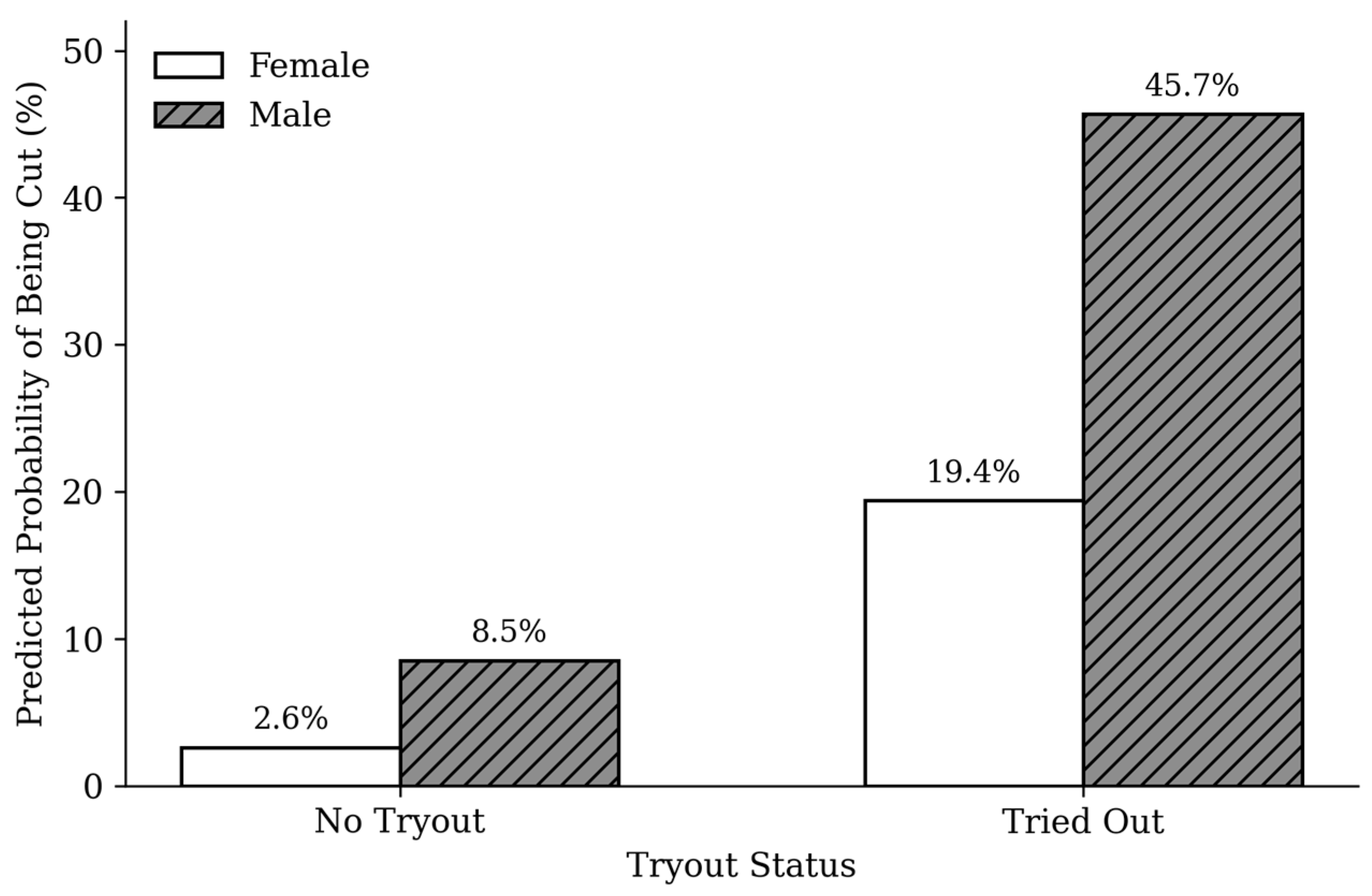
Because odds ratios do not lend themselves to intuitive interpretation, Figure 1 translates the coefficients presented in Table 4 into predicted probabilities of being cut, plotted separately for each combination of sex and tryout status, to facilitate interpretation of the tryout-adjusted model. As shown in Figure 1, the adjusted probability of being cut is higher for males than females at both levels of tryout status, but the sex difference is especially pronounced among respondents who tried out. Among those who did not try out, the predicted probability of being cut is 8.5% for males compared with 2.6% for females; among those who tried out, the corresponding probabilities rise to 45.7% and 19.4%, respectively.
Figure 1.
Predicted Probability of Being Cut, by Sex and Tryout Status. Note. Predicted probabilities are derived from the Model 2 logistic regression reported in Table 4.
Figure 1.
Predicted Probability of Being Cut, by Sex and Tryout Status. Note. Predicted probabilities are derived from the Model 2 logistic regression reported in Table 4.
Finally, as a simple descriptive supplement to the logistic regression, I also examined the raw conditional cut rate among respondents restricted to those who reported having ever participated in a formal tryout. In this subsample (N = 81), 44.2% of male tryout participants (19 of 43) reported having been cut, compared with 21.1% of female tryout participants (8 of 38)—a difference of 23.1 percentage points (p = 0.028). This unadjusted comparison closely parallels the regression-adjusted estimate in Model 2 and indicates that the sex difference in cutting is not an artifact of the modeling strategy.
6. Discussion
This research uncovered a large sex difference in reported team cuts. More than one-third of male respondents reported having been cut from a high-school team, compared with roughly one in eight female respondents. In this sample, therefore, exclusion from a roster position was substantially more common among males.
The tryout results provide related but distinct information. Males were also more likely to report having participated in a formal tryout, although the difference was smaller than the cut disparity. One obvious possibility is that males report more cuts simply because they are more often exposed to formal tryouts. The supplementary regression does not support that explanation: adjusting for ever having tried out reduces the male odds ratio for cutting only from 3.80 to 3.50.
This is a rather demanding adjustment because tryout participation may itself be shaped by athletic demand. Greater demand for limited roster positions may increase both the use of competitive tryouts and the likelihood of team cuts. The fact that adjustment for tryout experience produces little attenuation provides additional evidence that differential exposure to formal tryouts does not account for the observed sex difference in cuts.
The findings address an important gap identified in prior research. Deaner et al. (2012) argued that school-team participation may understate sex differences in demand for competitive sports and specifically raised the possibility that aspiring male athletes are cut more often. The present study offers initial individual-level quantitative evidence consistent with that expectation.
6.1. Fairness, Demand, and the Meaning of Equity
The results also illustrate a major but relatively ignored aspect of athletic equity in educational settings. A proportionality standard focuses on realized participation and asks whether male and female representation on teams corresponds to enrollment. An opportunity-relative-to-demand standard asks how many students seek participation but fail to obtain it. Neither participation counts nor cut rates alone provide a complete account of fairness.
Nevertheless, if a large sex difference in cutting is replicated, it would complicate the inference that approximate proportionality in realized participation implies approximate equality of athletic opportunity. A system could approach proportionality among those who play while one sex category contains substantially more students who were denied roster positions. This is the central implication of the study.
Seifried and Casey (2012) offer a complementary account of cutting. They view team roster limits as primarily shaped by staffing, facilities, financial resources, injury concerns, and coaches’ preferences for manageable squad sizes. Note that such constraints may themselves interact with the institutional environment created by Title IX. To the extent that schools face pressure to approximate gender parity in athletic participation, greater demand for participation on boys’ teams may be less readily accommodated by expanding male roster capacity. Organizational constraints determine how many positions are available, while demand determines how many students compete for them. The two explanations are therefore not necessarily in tension: a given capacity constraint will generate more exclusions when applied to a larger pool of aspiring athletes. At the same time, if coaching resources, facilities, or roster limits differ systematically between boys’ and girls’ programs for reasons independent of demand, capacity differences could themselves contribute to the observed sex disparity. The present data cannot distinguish these possibilities.
Seifried and Casey (2012) identified a less visible form of selection that may be especially relevant here. In their study of highly competitive boys’ basketball programs, Seifried and Casey describe offseason workouts, open gyms, and conditioning sessions as informal “pre-tryouts” (Seifried and Casey, 2012, p. 88), during which some prospective players effectively selected themselves out before formal selection occurred. There are reasons to suspect that such anticipatory withdrawal may be especially consequential for boys. Athletic competence and participation have long been identified as important resources in the construction of masculine identity and status among boys (Drummond, 2003; Messner, 1990). In an environment where boys also face a substantially greater risk of being cut, formally trying out when one expects rejection may therefore carry particular reputational and self-presentational costs. Some boys at the margin may withdraw before a formal cut occurs. Although the present data cannot test this possibility, its implication is noteworthy: to the extent that pre-tryout self-selection is more common among males, the large sex difference in cuts observed in these data would understate the true sex difference in unmet demand.
6.2. Limitations and Future Research
This research has important limitations. First, the sample is small and drawn from undergraduates at a single Midwestern university. It therefore does not permit national prevalence estimates. College students differ from the total population of high-school students in terms of socioeconomic resources, academic achievement, and extracurricular experiences, among other characteristics. These differences could affect the absolute prevalence of sports participation, tryouts, and cuts. The direction of the potential bias for the sex differences, however, is not obvious: selection into the college sample would have to operate jointly with sex and prior cutting experience to generate or erase the observed disparity. Replication in probability-based or geographically diverse samples is therefore essential.
Second, the survey is retrospective and relies on self-reports. Respondents may differ in recall or in how they interpret terms such as “tryout” and “cut.” Third, the study did not identify the sport associated with a tryout or cut. This is especially consequential because roster constraints vary substantially across sports, and males and females participate in different mixes of sports. Some portion of the aggregate sex difference could therefore reflect sport composition rather than different rates of cutting within the same sport.
Fourth, a team cut should not be equated with exclusion from all athletic activity. A student cut from a preferred school team may subsequently participate in another school sport, club or travel sport, intramurals, or noncompetitive physical activity. The present outcome captures the denial of a particular school-team opportunity, not the absence of every possible opportunity to be physically active.
Future research should collect larger and more representative samples and measure the specific sport attempted, number of sports attempted, number of tryouts and cuts, whether a cut followed a formal tryout, school size, public/private status, roster capacity, competitive level, club and travel participation, prior athletic experience, and the availability of alternative teams. Ideally, studies would measure demand, available roster positions, selection procedures, and realized participation simultaneously. Such data could determine whether the sex disparity observed here persists within sports and schools, and could identify the institutional mechanisms that produce it.
6.3. Policy Implications
The present data do not identify Title IX or proportionality enforcement as the definite cause of the observed sex difference in cuts. Accordingly, the results should not be read as a causal estimate of the costs of Title IX. They do, however, raise an empirical issue relevant to Title IX debates. Compliance discussions often rely heavily on realized participation and enrollment-based proportionality. If average demand for competitive sports differs by sex, participation ratios alone cannot reveal how many students wanted to play but were unable to obtain a roster position. Measures of unmet demand, including tryouts, cuts, waitlists, and student interest, could therefore complement participation counts when schools and policymakers evaluate athletic opportunity.
This perspective does not diminish the historic expansion of opportunities for girls or the anti-discrimination purpose of Title IX. Rather, it suggests that a comprehensive conception of equal opportunity should be attentive to exclusion experienced by students of either sex. Before policy conclusions can be drawn, the present pattern must be replicated with stronger data capable of distinguishing demand from sport composition, roster constraints, and institutional compliance decisions.
Funding
This research received no external funding.
Acknowledgments
I am grateful to Joonas Furst for research assistance. The article benefitted from several helpful comments from the anonymous reviewers.
Conflicts of Interest
The author declares no conflict of interest.
Appendix A. Survey Items and Response Distributions
The following are the exact survey questions and response options used to construct the measures of tryout experience and team cuts. Table A1 and Table A2 present the original response distributions by sex. For the analyses reported in the text, each measure was recoded into yes/no categories distinguishing respondents who had ever experienced a tryout or team cut from those who had not.
Appendix A.1. Tryout Experience
Did you ever have to try out for a sport? In other words, was the sport so competitive that you had to qualify by demonstrating you were good enough to make the team?
- Yes, I participated in tryouts many times
- Yes, but only once
- Never
Table A1.
Tryout Experience by Sex.
| Response | Female, % (n) | Male, % (n) |
|---|---|---|
| Participated in tryouts many times | 39.1 (25) | 49.2 (29) |
| Participated in tryouts only once | 20.3 (13) | 23.7 (14) |
| Never | 40.6 (26) | 27.1 (16) |
| Total | 100.0 (64) | 100.0 (59) |
Note. Percentages are within sex. For the analyses reported in the text, “Participated in tryouts many times” and “Participated in tryouts only once” were combined to create a yes/no measure of ever having participated in a formal tryout.
Appendix A.2. Team-Cut Experience
Have you ever been cut from the team? In other words, have you ever been denied participation in a school sport because they could include only a limited number of kids?
- Yes, I have been cut more than once
- Yes, I have been cut once
- No, I have always been able to join the team I wanted
Table A2.
Team-Cut Experience by Sex.
| Response | Female, % (n) | Male, % (n) |
|---|---|---|
| Cut more than once | 3.2 (2) | 11.9 (7) |
| Cut once | 9.5 (6) | 23.7 (14) |
| Never cut | 87.3 (55) | 64.4 (38) |
| Total | 100.0 (63) | 100.0 (59) |
Note. Percentages are within sex. For the analyses reported in the text, “Cut more than once” and “Cut once” were combined to create a yes/no measure of ever having been cut from a team.
References
- Carpenter, L. J.; Acosta, R. V. Title IX; Human Kinetics, 2005. [Google Scholar]
- Clarke, P.; Ayres, I. The Chastain effect: Using Title IX to measure the causal effect of participating in high school sports on adult women’s social lives. The Journal of Socio-Economics 2014, 48, 62–71. [Google Scholar] [CrossRef]
- Deaner, R. O.; Balish, S. M.; Lombardo, M. P. Sex differences in sports interest and motivation: An evolutionary perspective. Evolutionary Behavioral Sciences 2016, 10(2), 73–97. [Google Scholar] [CrossRef]
- Deaner, R. O.; Geary, D. C.; Puts, D. A.; Ham, S. A.; Kruger, J.; Fles, E.; Winegard, B.; Grandis, T. A sex difference in the predisposition for physical competition: Males play sports much more than females even in the contemporary U.S. PLoS ONE 2012, 7(11), e49168. [Google Scholar] [CrossRef] [PubMed]
- Drummond, M. J. N. The meaning of boys’ bodies in physical education. The Journal of Men’s Studies 2003, 11(2), 131–43. [Google Scholar] [CrossRef]
- Gavora, J. Tilting the playing field: Schools, sports, sex and Title IX; Encounter Books, 2002. [Google Scholar]
- Gleddie, D. L.; Sulz, L. D.; Humbert, M. L.; Zajdel, A. P. If you must cut athletes from school sports teams, consider best practices. Journal of Physical Education, Recreation & Dance 2019, 90(2), 24–30. [Google Scholar] [CrossRef]
- Kaestner, R.; Xu, X. Title IX, girls’ sports participation, and adult female physical activity and weight. Evaluation Review 2010, 34(1), 52–78. [Google Scholar] [CrossRef] [PubMed]
- Langton, V. Stop the bleeding: Title IX and the disappearance of men’s collegiate athletic teams. Vanderbilt Journal of Entertainment and Technology Law 2009, 12(1), 183–208. link to the article. [Google Scholar]
- Messner, M. A. Boyhood, organized sports, and the construction of masculinities. Journal of Contemporary Ethnography 1990, 18(4), 416–44. [Google Scholar] [CrossRef]
- National Federation of State High School Associations [NFHS]. High school athletics participation survey 2021–2022. 2022. link to the article.
- Seifried, C.; Casey, T. Managing the selection of highly competitive interscholastic sport teams: Recommendations from coaches on cutting players. Journal of Sport Administration & Supervision 2012, 4(1), 79–96. [Google Scholar] [CrossRef]
- Stevenson, B. Title IX and the evolution of high school sports. Contemporary Economic Policy 2007, 25(4), 486–505. [Google Scholar] [CrossRef]
- Stevenson, B. Beyond the classroom: Using Title IX to measure the return to high school sports. The Review of Economics and Statistics 2010, 92(2), 284–301. [Google Scholar] [CrossRef]
© 2026 Copyright by the author. This article is an open access article distributed under the terms and conditions of the Creative Commons Attribution (CC BY) license (https://creativecommons.org/licenses/by/4.0/).
